
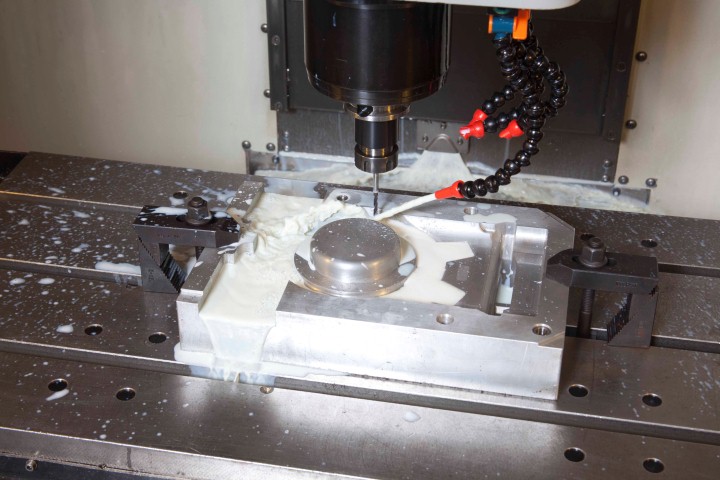
Tool and die making is the first and most critical step in the investment casting process. In this stage, precision dies are designed and manufactured using advanced CAD/CAM and CNC machining techniques. These dies are created by considering shrinkage factors of both wax and metal to ensure accurate final dimensions. The quality of the die directly impacts the accuracy, surface finish, and repeatability of the casting.
High-grade materials like aluminum or steel are typically used to ensure durability and long tool life. Proper design also ensures smooth wax injection and easy removal of wax patterns. This stage lays the foundation for producing high-quality cast components with tight tolerances and consistency.
Wax injection is the process of creating a replica of the final product using molten wax. The wax is heated to a semi-liquid state and injected into the die under controlled pressure and temperature. Once cooled and solidified, the wax pattern is removed carefully from the die. This wax pattern accurately represents the final casting in shape and dimensions.
Precision at this stage is essential because any defects in the wax pattern will transfer to the final product. Both automatic and manual injection machines are used depending on production requirements. The process ensures uniformity, smooth surface finish, and dimensional accuracy for further stages.
In the wax assembly stage, multiple wax patterns are assembled onto a central wax runner system to form a tree-like structure known as a cluster. This setup allows multiple components to be cast simultaneously, improving production efficiency. Each wax pattern is carefully inspected before assembly to ensure it meets quality standards.
The assembly process also includes attaching gating and feeding systems that help molten metal flow smoothly during casting. Proper alignment and strong joints are crucial to prevent defects during further processing. This stage plays a key role in optimizing production, reducing waste, and ensuring consistent casting quality.
Coating, also known as shell building, involves applying multiple layers of ceramic slurry and sand over the assembled wax patterns. The wax tree is repeatedly dipped into the slurry and then coated with fine refractory materials to build a strong ceramic shell. Each layer is dried under controlled temperature and humidity conditions before applying the next.
This process is repeated several times to achieve the required thickness and strength. The quality of coating determines the surface finish and structural integrity of the final casting. A strong and uniform shell is essential to withstand high temperatures during metal pouring.
De-waxing is the process of removing wax from the ceramic-coated shell to create a hollow mold. The coated assembly is placed in an autoclave or furnace where heat and pressure melt and drain out the wax. This process is also known as the “lost wax” method.
It leaves behind a precise cavity inside the ceramic shell that matches the final casting shape. Careful control of temperature and pressure is important to avoid cracking or damaging the shell. Proper de-waxing ensures a clean mold cavity, which is essential for producing defect-free castings.
Melting involves heating the selected metal alloy to its required temperature using induction furnaces or other advanced equipment. At the same time, ceramic molds are preheated to avoid thermal shock during pouring. Once the metal reaches the desired molten state, it is poured into the preheated ceramic shells under controlled conditions.
The molten metal flows through the gating system and fills the cavities completely. This stage requires precise temperature control, proper degassing, and removal of impurities to ensure high-quality casting. The metal then solidifies inside the mold, forming the desired component shape.
Heat treatment is performed after the casting solidifies and is removed from the mold. This process improves the mechanical properties of the casting, such as strength, hardness, and durability. Depending on the material and application, different heat treatment methods like annealing, quenching, or tempering are applied.
It also helps relieve internal stresses developed during solidification and enhances the overall performance of the component. Proper heat treatment ensures that the casting meets industry standards and customer specifications. This stage is essential for achieving the desired metallurgical structure and long-term reliability of the product.
Casting inspection is the final stage where each component undergoes strict quality checks. The castings are inspected visually and dimensionally to ensure they meet design specifications and tolerance requirements. Advanced testing methods such as non-destructive testing (NDT), hardness testing, and chemical analysis may also be used.
Any defects like cracks, porosity, or dimensional deviations are identified and corrected. This step ensures that only high-quality products are delivered to customers. Proper inspection guarantees reliability, performance, and customer satisfaction, making it a critical part of the entire manufacturing process.